


Nicholson Hollow

Buddy and Victoria Nicholson
Home in Lower Nicholson Hollow, Madison County, along the Hughes River. At the time of park creation, it was located on a 20-acre tract of land that Buddy Nicholson bought in 1925. This is the site with an historic occupation history going back to the entry of the Nicholsons into the part of Nicholson Hollow now in the park boundary when John and Anne Nicholson patented 170 acres in 1799. The land encompassing this site was deeded to their son-in-law William Berry in 1805 who sold to James Ward who held five enslaved people on the property. It then went through five more owners in the 19th century and eventually was acquired by Buddy Nicholson.
Photo by Audrey Horning


John Russ Nicholson Homesite


Old image of the house intact. The newer image is of the ruins.
This photograph shows a dwelling in Nicholson Hollow, one of the mountain communities that existed before the establishment of Shenandoah National Park. Homes such as this were the center of family life, providing shelter, security, and a place where generations lived and worked together. Built with locally available materials and adapted to the mountain landscape, these dwellings reflect the resilience, craftsmanship, and self-sufficiency of the families who called Nicholson Hollow home. Today, images of these homes help preserve the memory of the communities and traditions that once flourished in the mountains.
Schoolhouse


Fenton and Perry Sisk
Lower Nicholson Hollow, Madison County. Situated on a 97 acre tract of land at park creation. Park records indicate that 10 acres were under cultivation and another 30 employed as pasture. Origins of the land tract go back to a 1779 land grant to James McDaniel and a 487 land grant to Benjamin Lillard. Later owners of the land that would eventually make up the Fenton and Perry Sisk tract included Benjamin Nicholson (acquired 1819), Acrey Nicholson, Arnold Nethers, Hettie Hudson Lucy and Wade Yowell, and Emily Nicholson (it’s complex!). The house itself had two stories and five rooms at the time of park creation.
Photo by Audrey Horning

Old Mill
The pictures to the right show the ruins of an old mill and several tools that may have been used in its operation. Mills were important centers of economic activity in mountain communities, providing essential services such as grinding grain and processing local products. The surviving stonework and artifacts offer a glimpse into the technology, craftsmanship, and daily labor that supported community life. Together, these remnants help preserve the history of the people who lived and worked in the mountains.


Shade Tree
This old oak tree may have served as a shade tree for nearby residents, providing relief from the summer heat and a gathering place for family and community activities. Large trees were often important landmarks around homes, schools, churches, and farms, offering shelter for people, livestock, and social gatherings. Having stood for generations, this oak serves as a living connection to the past and the people who once called these mountains home.

Irrigation and Water
This photograph shows the opening of a natural spring that once provided a dependable source of fresh water for nearby residents. Springs were essential to daily life in the mountain communities, supplying water for drinking, cooking, cleaning, and livestock. Many families carefully protected and maintained these water sources, recognizing their importance to the household. Features such as this spring opening offer insight into how mountain residents relied on and adapted to the natural resources of the landscape.

Churches
The larger image to the right shows Hughes River Church, while the image in the lower left depicts Dark Hollow Falls Church. Churches served as important centers of spiritual, social, and community life in the mountain settlements. In addition to worship services, they provided places for gatherings, celebrations, education, and mutual support. These historic churches reflect the strong faith traditions and close-knit relationships that helped sustain mountain communities for generations.


Families
This photograph shows the family of Charles Edgar “Ed” Hawkins and Minnie May Hawkins, who lived along the Rapidan River in Madison County near Hoover’s Camp. The image provides a glimpse into family life in the mountain communities that once existed in the region. Although two of their children are not pictured, the photograph preserves the memory of a family whose lives were closely connected to the land, their neighbors, and the traditions of the mountains. Images such as this help tell the personal stories behind the communities that once called these mountains home.
Corbin Hollow


Fennel Corbin
This photograph shows the family of Charles Edgar “Ed” Hawkins and Minnie May Hawkins, who lived along the Rapidan River in Madison County near Hoover’s Camp. The image provides a glimpse into family life in the mountain communities that once existed in the region. Although two of their children are not pictured, the photograph preserves the memory of a family whose lives were closely connected to the land, their neighbors, and the traditions of the mountains. Images such as this help tell the personal stories behind the communities that once called these mountains home.

Corbin Hollow Schools
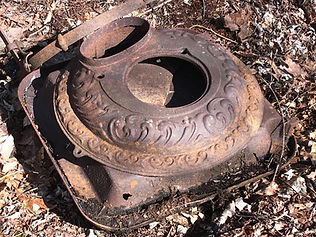
The photograph to the right shows Ms. Nellie Walton, a teacher in Corbin Hollow. Teachers played a vital role in mountain communities, providing education to local children and often serving as respected community leaders. The accompanying image shows the lid of the wood stove that helped heat the schoolhouse during the colder months. Wood stoves were essential in one-room schools, providing warmth and comfort for students and teachers throughout the school day. Together, these images offer a glimpse into the educational experiences and daily life of children in the mountain communities.

Cemeteries

Nicholson Family
The images to the right show the Nicholson Family Cemetery, an important link to the history of the mountain community and the families who once lived there. One of the photographs features the cemetery gate, which marks the entrance to a place of remembrance and reflection. Family cemeteries such as this preserve the names, stories, and legacies of generations of residents, providing descendants with a tangible connection to their ancestors and the communities they helped build.


Jenkins family
This image shows a headstone in the Benjamin Jenkins Cemetery, a historic burial ground associated with the mountain communities of the region. Headstones provide valuable connections to the past, preserving the names, dates, and memories of those who lived and worked in the area. Cemeteries such as this serve as important places of remembrance for descendants and help document the history of the families who called these mountains home.

Cave family
This image shows the Cave Family Cemetery, a historic burial ground that preserves the memory of generations of family members who lived in the mountain community. Family cemeteries were often established near homes and farms, providing a lasting connection between the land and the people who lived there. Today, cemeteries such as this remain important places of remembrance, helping descendants trace their heritage and honoring the lives of those who helped shape the history of the region.

Alger, Smith and Grayson family
This image shows the gravestone of a member of the Sisk family, one of the families who lived in the mountain communities of the region. Gravestones serve as lasting memorials, preserving the names and memories of those who came before. They provide valuable historical and genealogical information while offering descendants a tangible connection to their family heritage. Markers such as this help tell the story of the people whose lives and experiences shaped the history of the mountains.

Household Items

Stove
This image shows the base of a stove that was used for both heating and cooking in a mountain home. Stoves were among the most important household items, providing warmth during the winter months and a place to prepare daily meals. Often located at the center of family life, they served as gathering places where people cooked, shared stories, and spent time together. Artifacts such as this stove base offer a glimpse into the daily routines and self-sufficient lifestyle of mountain families.

Pottery
This image shows a piece of pottery used for eating or drinking in a mountain household. Pottery was an important part of daily life, serving practical purposes in the preparation, storage, and consumption of food and beverages. Durable and reusable, these items were often used for many years and sometimes passed down through generations. Artifacts such as this pottery help illustrate the everyday experiences of mountain families and provide insight into the material culture of the communities that once lived in the region.

Woodworking
This image shows a chestnut fencepost, a reminder of the importance of the American chestnut tree to mountain communities. Before the chestnut blight devastated the species in the early twentieth century, chestnut wood was widely used for building materials, fence posts, barns, and homes because of its strength and natural resistance to decay. Many chestnut fence posts remained standing for decades, reflecting the durability of the wood and the craftsmanship of those who worked the land. Artifacts such as this help preserve the history of both the mountain communities and the once-abundant chestnut forests that shaped their way of life.

Transportation
This image shows an automobile found at Betty’s Rock, one of the many artifacts that remain from the mountain communities that once existed in the area. The presence of a car challenges the common misconception that mountain residents were isolated from modern technology. Automobiles provided transportation, connected families to nearby towns and markets, and reflected the increasing influence of twentieth-century innovations on daily life. Today, the vehicle serves as a reminder of the people who lived and worked in these mountains and the changing world they experienced.

Ruins and Chimneys

Chimenys
These remaining chimneys are among the few physical traces left after the homes of mountain residents were demolished. Often built from locally gathered stone or brick, chimneys were designed to withstand the elements and frequently outlasted the structures they once served. Today, they stand as silent reminders of the families who lived in these homes, preserving a tangible connection to the communities that once thrived in the mountains. These surviving features help tell the story of the people, traditions, and way of life that existed before the establishment of Shenandoah National Park.


Buildings
This image shows the foundation and remaining structural elements of a former building in the mountain community. Although the structure itself is gone, the foundation provides evidence of the homes, businesses, and other buildings that once stood here. These remnants offer valuable insight into the lives of the people who lived and worked in the mountains, helping to preserve the history of communities that have largely disappeared from the landscape.


Reference for the Library of Congress Images
United States Resettlement Administration, Rothstein, A., photographer. (1935) Home of Bailey Nicholson, Shenandoah National Park, Virginia. United States Shenandoah National Park Va. Shenandoah National Park Virginia, 1935. Oct. [Photograph] Retrieved from the Library of Congress, https://www.loc.gov/item/2017721435/.
United States Resettlement Administration, Rothstein, A., photographer. (1935) Weaving a basket, Shenandoah National Park, Nicholson Hollow, Virginia. United States Shenandoah National Park Va. Shenandoah National Park Virginia, 1935. Oct. [Photograph] Retrieved from the Library of Congress, https://www.loc.gov/item/2017721587/.